8 November 2026 · Soldr
Why your AMS1117 runs hot, and when a buck converter is the fix
Short answer: a linear regulator like the AMS1117-3.3 burns the voltage difference as heat: (Vin − 3.3 V) × current. From 5 V at 0.8 A that's 1.36 W, more than the 1.2 W its datasheet guarantees for the common SOT-223 package. A buck converter like the XL4015 switches instead and wastes far less (87 % efficient at 12 V to 5 V, 5 A in its datasheet). Use a linear regulator for small currents and small drops; use a buck for big drops or big currents.
A regulator that's too hot to touch is a common sight on a first battery or 12 V project. Sometimes it's fine, sometimes it's about to shut down, and the datasheet tells you which. Both parts here have reference pages: the AMS1117-3.3 and the XL4015 buck converter.
The linear regulator: AMS1117-3.3
From the maker's datasheet:
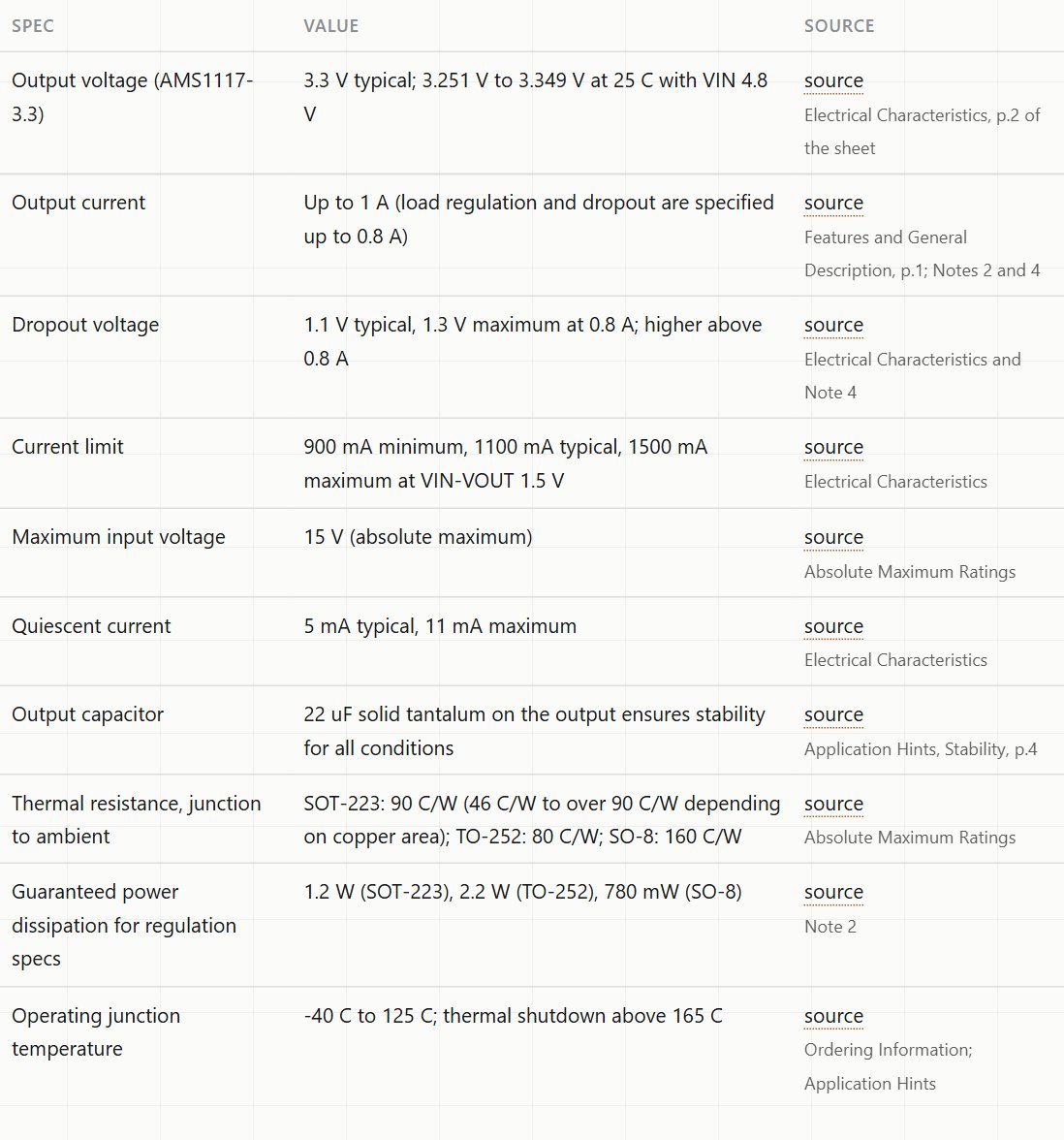
- 3.3 V output (3.251 to 3.349 V at 25 °C), up to 1 A; dropout and load regulation are specified up to 0.8 A.
- Dropout: 1.1 V typical, 1.3 V maximum at 0.8 A. So the input needs to be about 4.6 V or more for a steady 3.3 V at full load.
- Absolute maximum input: 15 V.
- Thermal resistance, junction to air: about 90 °C/W for SOT-223 (46 to over 90 °C/W depending on copper area). Guaranteed dissipation for the regulation specs: 1.2 W for SOT-223.
- Thermal shutdown above 165 °C.
- An output capacitor is needed for stability; the sheet recommends 22 µF solid tantalum.
Do the heat sum
A linear regulator passes the full load current, and drops the extra voltage across itself. So the power it turns into heat is:
P = (Vin − Vout) × I
- 5 V in, 0.8 A: (5 − 3.3) × 0.8 = 1.36 W. Above the 1.2 W the datasheet guarantees for SOT-223, and at 90 °C/W the junction would rise roughly 120 °C over the air around it. Expect it to shut down or drift.
- 5 V in, 0.2 A: 1.7 × 0.2 = 0.34 W. Warm, fine.
- 12 V in, 0.2 A: 8.7 × 0.2 = 1.74 W. Too much, even at a modest current.
The lesson: a linear regulator is great for a small drop at a small current, such as 5 V USB to 3.3 V for a few sensors. A big drop, or a big current, turns into heat.
Watch the dropout, too
The other common AMS1117 mistake goes the other way: too little input. Three AA cells give about 4.5 V. That's below the roughly 4.6 V the datasheet needs for full-load regulation, so the output sags under load. At light load it may be fine; at 0.8 A it won't be.
The switching regulator: XL4015
A buck converter switches the input on and off and smooths the result, so it doesn't burn the voltage difference. From the XL4015 datasheet:
- Input 8 to 36 V (absolute maximum 40 V). Output adjustable from 1.25 V to 32 V, set by a resistor divider against a 1.25 V reference.
- 5 A output capability; 7 A typical switch current limit.
- Efficiency in the sheet's test circuit: 87 % at 12 V in, 5 V out, 5 A, and 93 % at 24 V to 12 V, 4 A.
- 180 kHz switching; 0.3 V minimum dropout.
Efficiency still means some loss. At 12 V to 5 V and 5 A, 87 % efficiency is about 3.7 W lost as heat (25 W out ÷ 0.87 = 28.7 W in). The sheet gives 30 °C/W for the bare package in free air, so full current needs cooling. At a 1 A load the loss is a small fraction of that.
Two practical rules for the module:
- Set the output before you connect the load. Turn the trimmer while measuring the output with a multimeter. A board on the 5 V input of an ESP32 should see 5.0 V, not whatever the module shipped at.
- Respect the 8 V minimum input. Below that the chip doesn't regulate. A 5 V USB supply is not enough to make 3.3 V with an XL4015.
Which to use
- 5 V to 3.3 V, a few hundred mA: AMS1117 is simple and quiet.
- 12 V or a battery pack down to 5 V or 3.3 V: a buck converter, then (if needed) a small linear regulator after it.
- Anything above about 1 W of loss in the linear regulator: switch to a buck.
Soldr shows a power budget for each build and states its power plan in the chat. Check the regulator heat yourself with the formula above whenever the input is well above the output. More in the power budget guide.
On Compoden: AMS1117-3.3, XL4015 buck converter. Describe your build on app.soldr.ai. Sign in and get 100 credits free.