22 August 2026 · Bharat Raj
Soldr vs Grok Bot: what ₹150 buys against $120 a month
This week an ad crossed our feed: a creator building a little desktop assistant on an ESP32, with three AI agents named VOLT, KODA and PINOUT — one for "idea and parts", one for code, one for wiring — built on Grok Bot, the new persistent-agent platform from SpaceXAI. Someone had rebuilt our exact workflow out of general-purpose agents, to make exactly the kind of thing people build with Soldr every day.
Honestly? We were flattered. And since the obvious next question is "so which one should I use to actually build something" — here is the straight comparison, with every number about us taken from our deployed billing code, and every number about Grok Bot from its launch coverage.
What Grok Bot is
Grok Bot launched in beta on 11 August 2026 as the first joint product of the SpaceX/xAI and Anysphere (Cursor) merger. Each bot gets its own persistent computer in the cloud, signs into your tools, and keeps working with long-running memory even when your laptop is closed. It is genuinely impressive infrastructure.
It is also general-purpose, and priced like enterprise software:
- $120 per seat per month on Cursor Teams Premium — over ₹10,000/month at current rates
- $200/month for individual Cursor Ultra subscribers
- $300/month via SuperGrok Heavy
The three hardware bots in that ad are not a product — they are one user's configuration. You subscribe, then assemble and prompt your own "parts bot", "code bot" and "wiring bot", and teach them what you know about electronics.
What Soldr is
Soldr is one engine, purpose-built for exactly this job. You describe what you want to make, in ordinary words. It selects the parts — checked against each other for voltage, current, bus conflicts and pin count — plans the wiring pin-by-pin for your exact board, draws the schematic, and writes firmware it compiles for 674 board targets before you see it. Then the part that no agent platform does: the parts actually arrive at your door. Every component it picks comes from a live Indian catalogue of 12,000+ SKUs, and ships COD across India.
The price comparison
| Grok Bot | Soldr | |
|---|---|---|
| To start | $120–300/month subscription | Free — 25 credits on sign-in, and your first code generation is free at any size |
| Asking questions | metered against your seat | Always free — troubleshooting, "will 5V damage this", post-purchase help, all of it |
| Generating code | included in subscription | Pay per use: 1 credit (₹1) per 200 tokens of work, hard-capped at ₹150 per generation |
| A blink sketch | — | about ₹5–10 |
| A 1,200-line game with EEPROM high scores | — | ₹150, the most we will ever bill for one generation |
| Monthly commitment | ₹10,000+ | ₹0 — no subscription exists to cancel |
| The parts | you source them yourself | picked from live stock, shipped to you, COD available, free shipping on prepaid orders over ₹999 |
Put one way: a single month of Grok Bot's entry tier costs the same as generating our largest-possible sketch seventy times — or several hundred ordinary ones.
That exact build, run live while writing this post
The project in the ad is an ESP32 desktop assistant with a little screen. So we typed exactly that into Soldr as a signed-out guest — "a little desktop assistant on an ESP32 — a small OLED screen that shows the time, and it greets me when I sit down at my desk" — and screenshotted what came back. No retakes, no staging.
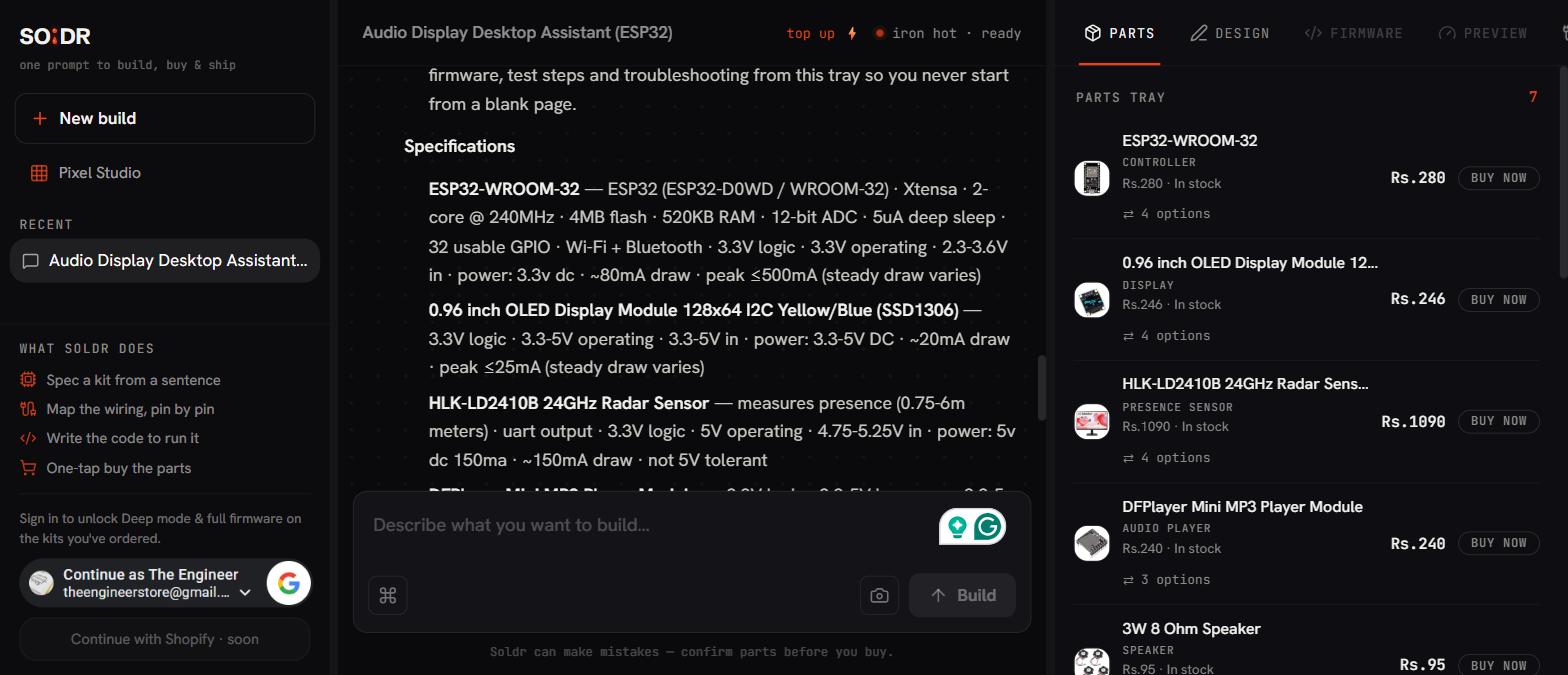
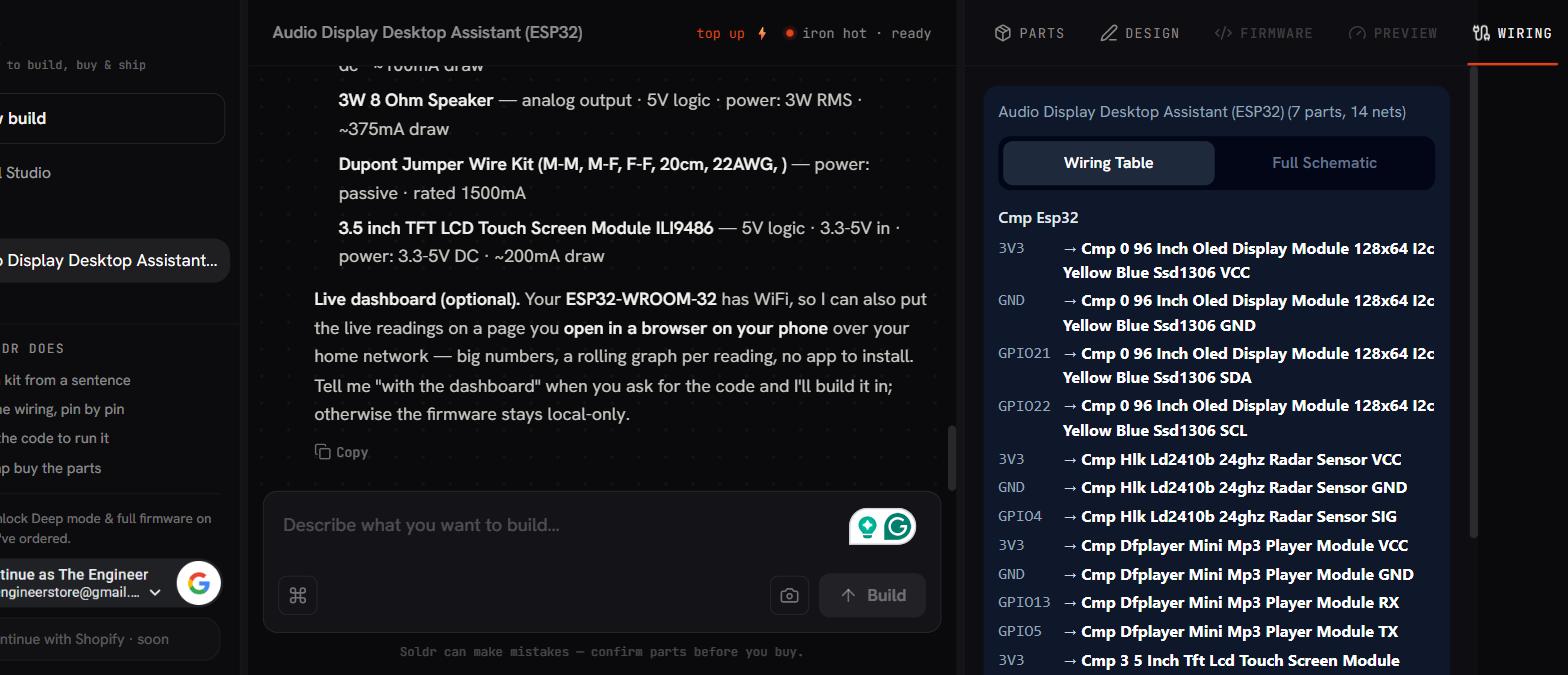
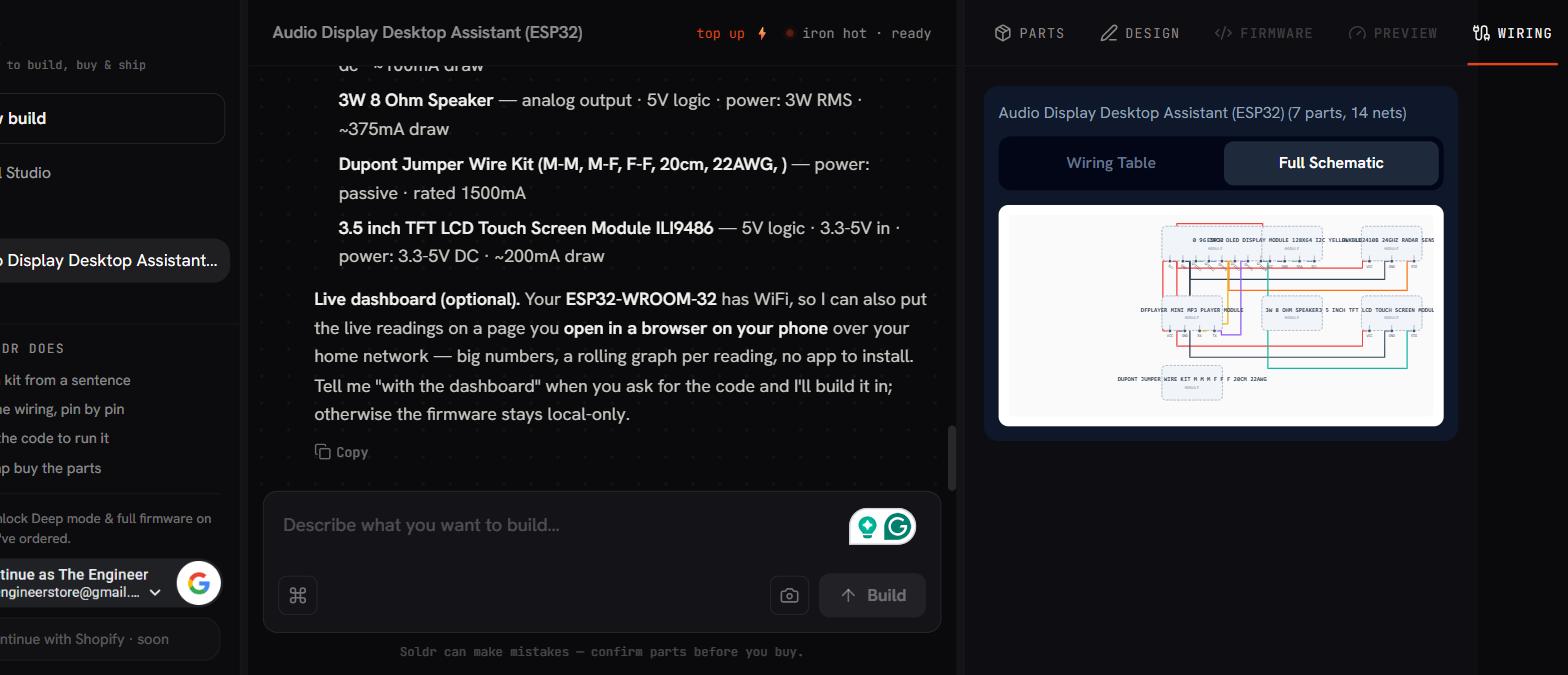
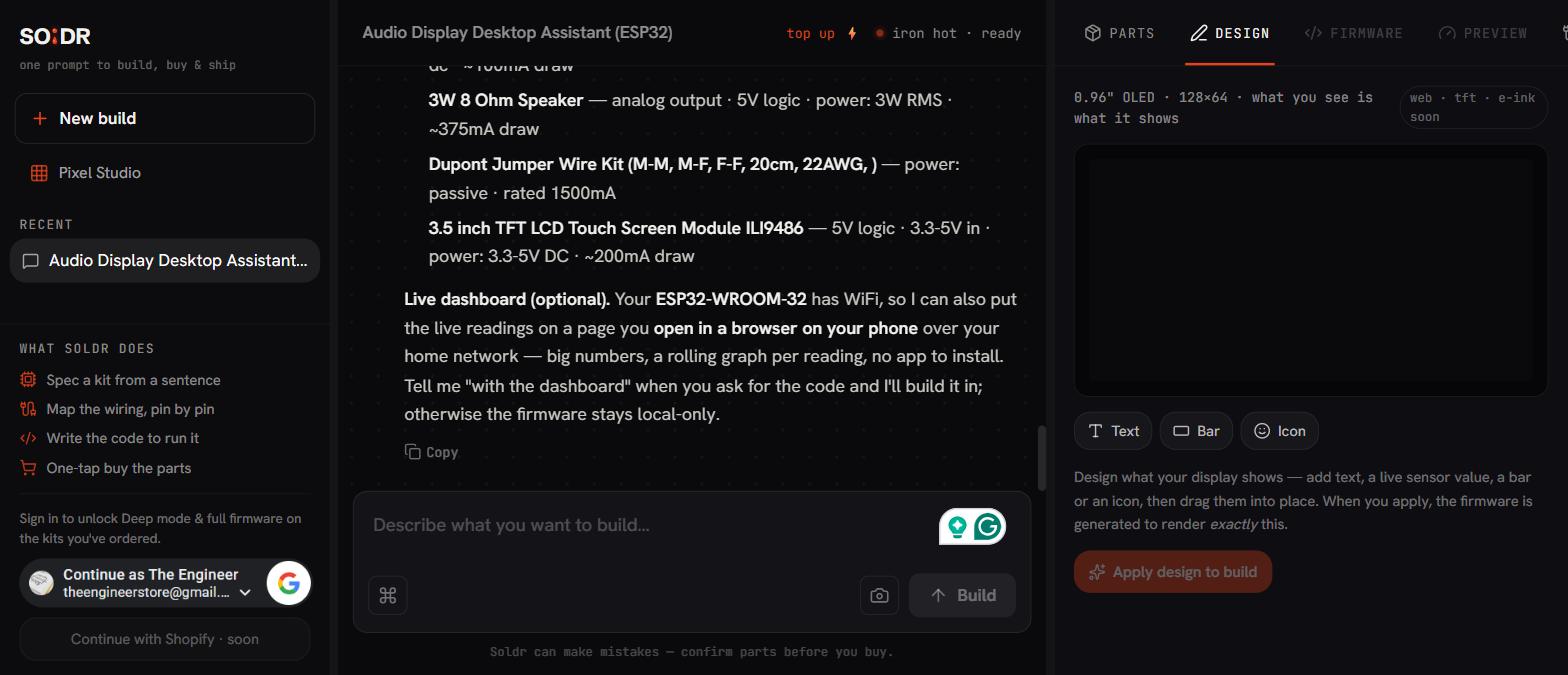
The bill for the core of it, from that live tray: ESP32-WROOM-32 at ₹280 and the OLED at ₹246. Add the firmware — a build this size meters well under the cap, and if it is your first generation it is free. The brain and face of a desktop assistant for about ₹530, no subscription, delivered COD. Against a $120 monthly seat, the hardware costs less than one week of the software.
The difference that matters more than price
A general agent designing hardware works from imagination. It will confidently specify a sensor variant that doesn't exist at your supplier, a module whose pins its training data got wrong, a "5V" part that is actually 3.3V. You find out after the parts arrive — from somewhere else, in two weeks.
Soldr is grounded in the store it is attached to. It cannot recommend a part we don't stock; when the right part genuinely doesn't exist, it tells you that instead of inventing one. The wiring comes from per-board pin data we curate and correct daily, not from a model's memory. And when something is wrong on our shelf, the engine inherits the fix the same day.
When to use which
If you want a fleet of persistent agents running your email, your spreadsheets and your deploys, Grok Bot is built for that and priced for teams that need it.
If you want the thing on your desk, blinking, by Friday — describe it to Soldr, pay for exactly the code you generate, and open the box when it arrives.
Grok Bot facts and pricing from launch coverage by VentureBeat and Implicator.ai (August 2026). Soldr numbers are the live values in our deployed billing code on the day of writing. If any of this goes stale, tell us and we will fix the post — that is rather the point.